 ×
×
I still remember a conversation with a European brand manager a few years ago. They had been trying to produce their own line of workwear in-house but kept running into delays, high costs, and quality inconsistencies. They were frustrated. That’s when they started exploring OEM workwear manufacturers in Asia—and everything changed.
OEM workwear manufacturing has been quietly reshaping how global brands approach uniforms and safety clothing. More and more companies are realizing it’s not just a cost-saving measure—it’s a way to remain flexible, innovative, and competitive in a fast-moving market.
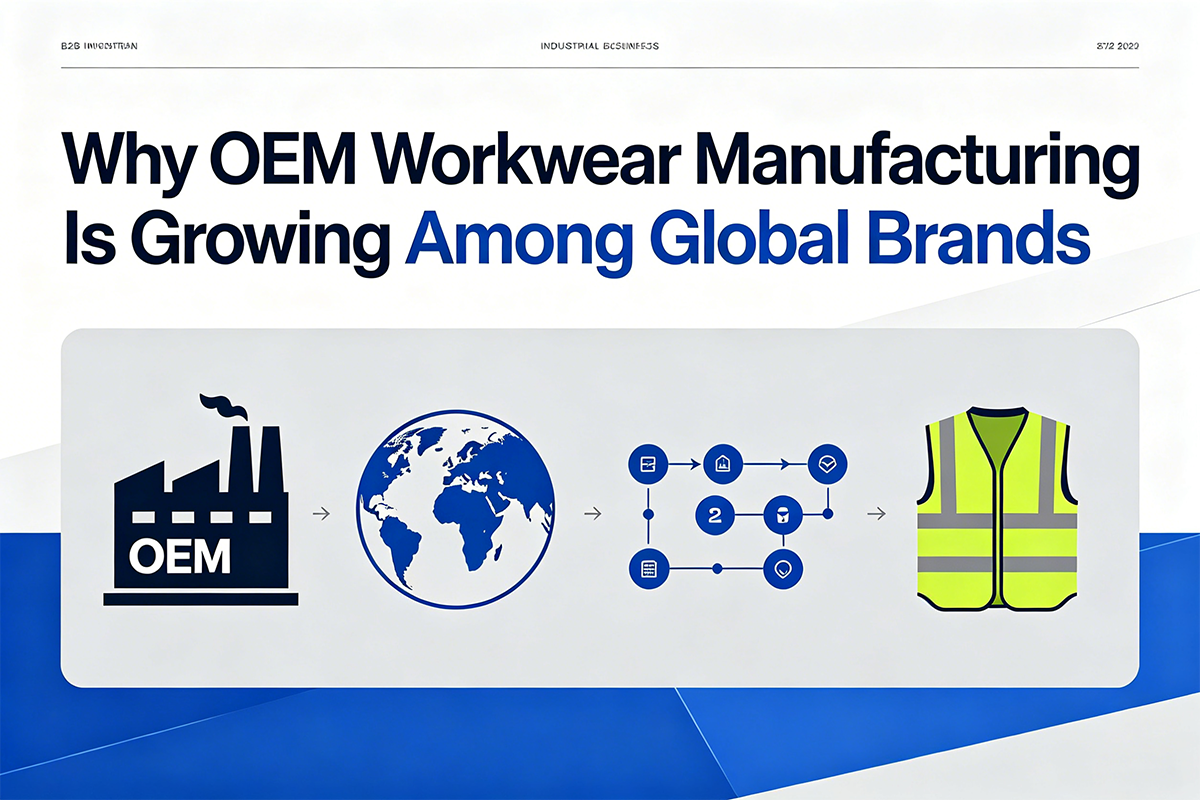
It might seem counterintuitive. If you own the brand, why not make your own products? For many companies, in-house production comes with hidden headaches.
First, there’s capital investment. Setting up a manufacturing facility requires machinery, materials, and skilled labor. Then there’s the ongoing cost of maintenance, staff training, and quality control. For smaller or mid-sized brands, that investment doesn’t always make sense—especially if their workwear line is just one part of a larger product portfolio.
Second, speed is a major issue. In-house production often slows down the development cycle. Trying to launch a new uniform style or respond to market feedback can take months if you’re managing production internally.
Third, geographic limitations matter. Brands operating globally often struggle to reach markets efficiently with in-house production, whereas a well-chosen OEM workwear manufacturer can produce closer to raw material sources and ship to multiple regions faster.
OEM—Original Equipment Manufacturer—basically means a third-party factory produces your design according to your specifications. For global brands, this model offers several clear benefits.
One of the biggest advantages is flexibility. You can scale production up or down based on demand without the burden of idle machinery or unused warehouse space. It also allows brands to focus on their core strengths: marketing, design, and sales, while leaving the complexities of garment production to specialists.
Another advantage is expertise. A good OEM workwear manufacturer has years of experience in fabric selection, stitching, reflective tape placement, and safety compliance. They know how to make garments that meet global standards, from EN ISO in Europe to ANSI in North America, often without the brand having to manage every technical detail.
For brands that want private label workwear, OEM factories are ideal. You can have your logo, color palette, and packaging without investing in production infrastructure yourself. It’s the same concept that has worked for electronics, shoes, and apparel for decades—it just works particularly well in uniforms and safety clothing, where technical specifications matter as much as aesthetics.
One thing brands love about OEM workwear manufacturing is the ability to manage inventory more efficiently. Producing in-house often leads to either overstocked warehouses or stockouts.
With OEM partners, brands can order smaller batches first, test the market, and then scale production as demand grows. Some suppliers even offer flexible production schedules and buffer stock strategies that make it easier to respond to seasonal demand or sudden spikes in orders.
I once worked with a mid-sized US company that switched to an OEM model. Before, they had warehouses full of uniforms that didn’t sell quickly. Now, they produce on-demand in small batches, which has reduced both waste and storage costs significantly.
In today’s market, speed matters. Brands can’t afford to spend months perfecting a new line while competitors move faster. OEM workwear manufacturers often have streamlined processes for prototyping, sampling, and bulk production.
Many factories can turn around samples in a week or two, and with clear communication, revisions happen quickly. This reduces the time from concept to market considerably.
The faster development cycle isn’t just about being first—it’s about staying relevant. Uniform styles, fabrics, and safety requirements change. A brand that can respond quickly is better positioned to maintain market share and satisfy client expectations.
The past few years have been turbulent for global supply chains. Shipping delays, tariffs, and material shortages have forced brands to reconsider their manufacturing strategies.
OEM workwear manufacturing in Asia has become particularly attractive because of established supply chains for fabrics, hardware, and accessories. Manufacturers often have strong logistics networks, which helps brands navigate international shipping more efficiently.
Brands can source materials locally within the factory’s region, reducing lead times and costs, while still maintaining quality standards. In an unpredictable global market, that reliability is invaluable.
Asian factories, especially in China, Vietnam, and Bangladesh, have become the go-to for many European and North American brands for several reasons.
Cost efficiency is obvious, but it’s more than just cheap labor. These factories have deep experience in technical workwear, compliance with multiple international standards, and the ability to produce complex designs at scale.
Another factor is flexibility. Brands can request private label workwear or specific customizations without committing to large, risky investments. Many factories also handle multiple aspects of production, from sourcing fabrics to packaging, which simplifies the supply chain.
Finally, communication has improved dramatically. Many OEM workwear manufacturers now operate with dedicated account managers who speak English, manage logistics, and provide production updates, making collaboration smoother than ever.
A European safety equipment brand I worked with recently decided to move their entire uniform line to an Asian OEM manufacturer. Previously, in-house production meant delays of three to four months per season. After the switch, sample approval took less than two weeks, bulk production about six weeks, and inventory risk dropped dramatically.
They could finally focus on branding, marketing, and sales, while leaving production to experts. The quality was consistent, and the team could launch seasonal designs without worrying about raw material sourcing or labor management.
OEM workwear manufacturing isn’t just a trend—it’s becoming a necessity for global brands that want to remain competitive. The model offers:
Brands that embrace OEM partnerships can move faster, respond to market changes more efficiently, and maintain high-quality standards across regions.
Competition in the global workwear market is only getting tougher. For brands, producing everything in-house is increasingly impractical. OEM workwear manufacturing provides flexibility, faster development cycles, and reliable quality control, all while keeping costs manageable.
By partnering with experienced OEM factories, brands can focus on what they do best—designing, marketing, and growing—without the constant headache of running production themselves.

 EN
EN


