 ×
×
I remember the first time a client asked me to handle their OEM workwear order. They were focused entirely on the price, thinking a cheap quotation was all that mattered. When the shipment arrived, several uniforms had peeling reflective strips, loose stitching, and some colors weren’t even right. That day I realized just how tricky custom workwear can be.
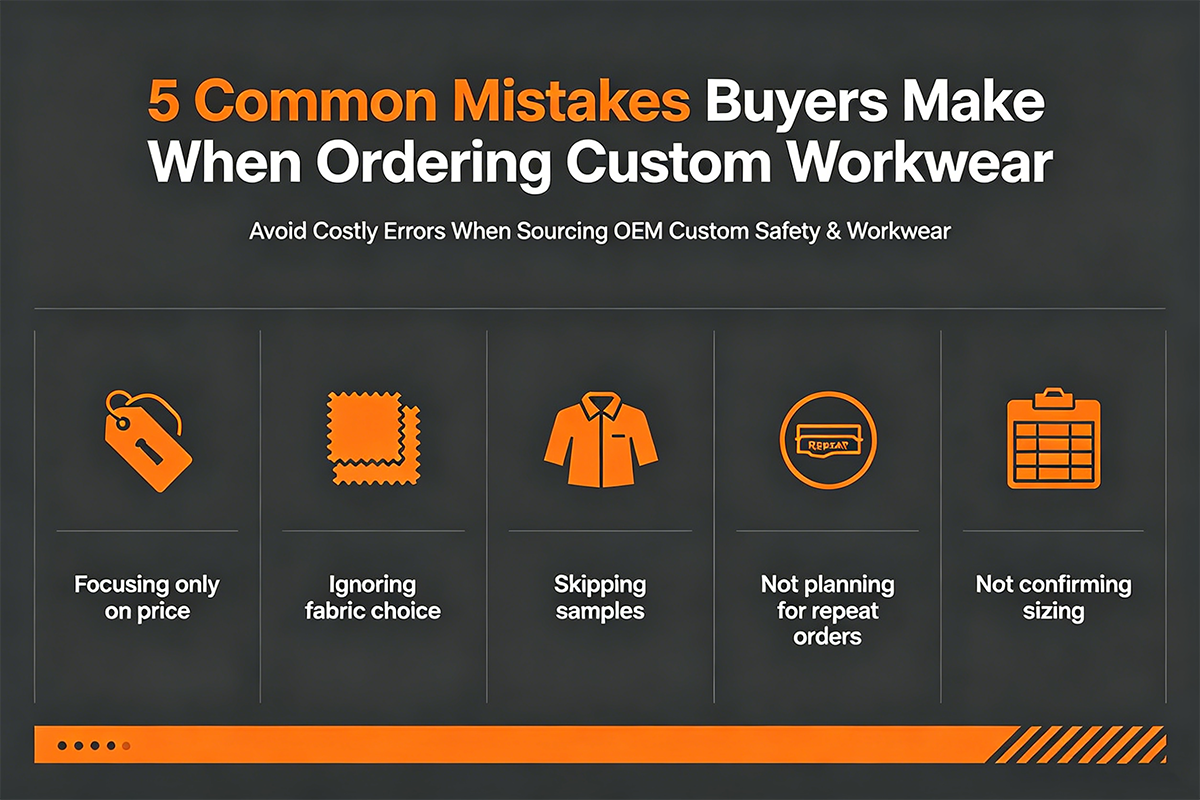
Many buyers think ordering custom uniforms is as simple as picking a design and sending a purchase order. In reality, the mistakes often start long before production begins—and they can be expensive to fix. Over the years, I’ve noticed five recurring pitfalls that seem to catch every newcomer at least once.
Price is the first thing most buyers notice. I get it—everyone wants a good deal. But in custom workwear, the lowest quote often comes with hidden compromises.
Some manufacturers cut costs in ways that aren’t obvious at first. They might use thinner fabric, simplify the stitching, or lower the quality of reflective tape. Everything may look fine in pictures or on paper, but once the uniforms are used on-site for a week or two, the differences become painfully obvious.
What’s worse, cheap quotes often exclude costs like sampling, revisions, packaging, or color matching. I’ve seen clients think they got a bargain, only to spend twice as much fixing issues during production.
A manufacturer that explains costs clearly is usually worth a little extra money upfront—it prevents headaches down the line.
Fabric choice is one of the most underestimated parts of ordering custom workwear. Two uniforms can look almost identical in photos but behave completely differently in real life.
I once had a client who insisted on a particular cotton-poly blend because it was “soft.” A week later, after their staff wore the uniforms in a warehouse, they complained about shrinkage and the fabric tearing at seams. Conversely, polyester blends or ripstop fabrics might feel stiffer initially but last much longer, especially under tough working conditions.
Fabric affects comfort, durability, breathability, and even color retention. Simple details like stretch or moisture-wicking can make a huge difference in daily use. My advice: always test a small fabric sample in real work conditions before committing to bulk production. It saves a lot of frustration later.
Another mistake I see frequently is buyers rushing into bulk production without proper samples. Some assume that once a digital design is approved, everything will be fine. In my experience, that rarely works.
Samples are critical because they show how the garment actually feels and functions. They reveal issues you might never notice on a drawing: a pocket in the wrong spot, sleeves that are too tight, or reflective tape that doesn’t align correctly.
One client skipped a second-round sample to save a few days. When the full order arrived, almost half the jackets needed adjustments. That delay cost far more time and money than the extra week spent on samples.
Going through one or two sample revisions might seem tedious, but it’s a tiny investment compared to correcting mistakes in thousands of uniforms.
Custom workwear is rarely a one-time purchase. Teams expand, old uniforms wear out, and companies usually reorder periodically.
Many buyers don’t think ahead. They assume that if the first batch is good, repeat orders will automatically match. In reality, fabrics can be discontinued, dye lots can vary, and suppliers might switch materials. Without planning, your second batch might not match the first at all.
I always tell clients to archive fabric specs, patterns, and color codes with their manufacturer. A good OEM workwear supplier will maintain production records, so repeat orders stay consistent. Discuss this before the first production run, not after you notice differences.
Sizing seems straightforward—everyone has S, M, L, XL, right? Wrong. Different regions, industries, and body types require careful sizing consideration.
I’ve seen warehouse workers wearing uniforms meant for European sizing complain that the sleeves are too short. American sizing can be too loose for smaller staff. Even within one company, inconsistent sizing leads to frustration and extra replacement costs.
A professional manufacturer will provide a clear sizing chart, physical sample sizes for fitting, and sometimes graded measurements for different regions. Confirming sizing before production avoids one of the most common complaints in custom workwear.
From my experience, most production issues don’t come from the manufacturer—they come from unclear expectations at the start. Price, fabric, sampling, repeat orders, and sizing are all small decisions that quietly influence the final result.
Getting these right means smoother production, fewer returns, and uniforms that actually perform on the job. It also saves money over time and prevents quality problems from creeping in.
Ordering custom workwear is more than picking a style and placing an order. Taking the time to choose the right manufacturer, test fabrics, review samples, confirm sizing, and plan for repeat orders makes all the difference.
Choosing the right workwear manufacturer can save significant costs and prevent quality issues in future production runs. It’s not just about getting the uniforms delivered—it’s about getting uniforms that last, fit well, and make your team look professional every day.

 EN
EN


